Thursday, January 16, 2014

Adventures in production home brewing

I over promised beer. Again. It happens. This time it isn't a constraint of quantity or capacity, but rather time.

It was on Wednesday of last week that I realized I had a situation on my hands. I committed to brewing some beer for a event later this month. Unfortunately, I didn't take into account that I'd be out of the country for a week, pretty much blowing a giant hole into the conditioning, racking, and packaging period for the planned beer - a pale ale. I'd need to get the beer brewed, fermented, carbonated and packaged within 7 days.

I brewed on a Friday night and adjusted the recipe to account for the complete lack of conditioning time. Out of necessity this would be a very sessionable pale ale at 1.042 OG. In addition to 2-row, I used some extra grain that I had laying around: the last of a bag of C40, some Victory malt, and a pound of Carapils. For the hop bill, I rummaged through my freezer for hops with distinctive tropical flavor that might open the minds of the typical "that's too bitter" crowd. And I dosed my water with my go to pale, hoppy beer treatment for Warren, OH water: more gypsum than calcium chloride and a ml or two of lactic acid.

Since I wouldn't be able to dry hop it, I dumped a ton of hops into the knockout addition and used a 30 minute whirlpool steep at 180 degrees to get fresh flavor and aroma in the beer.

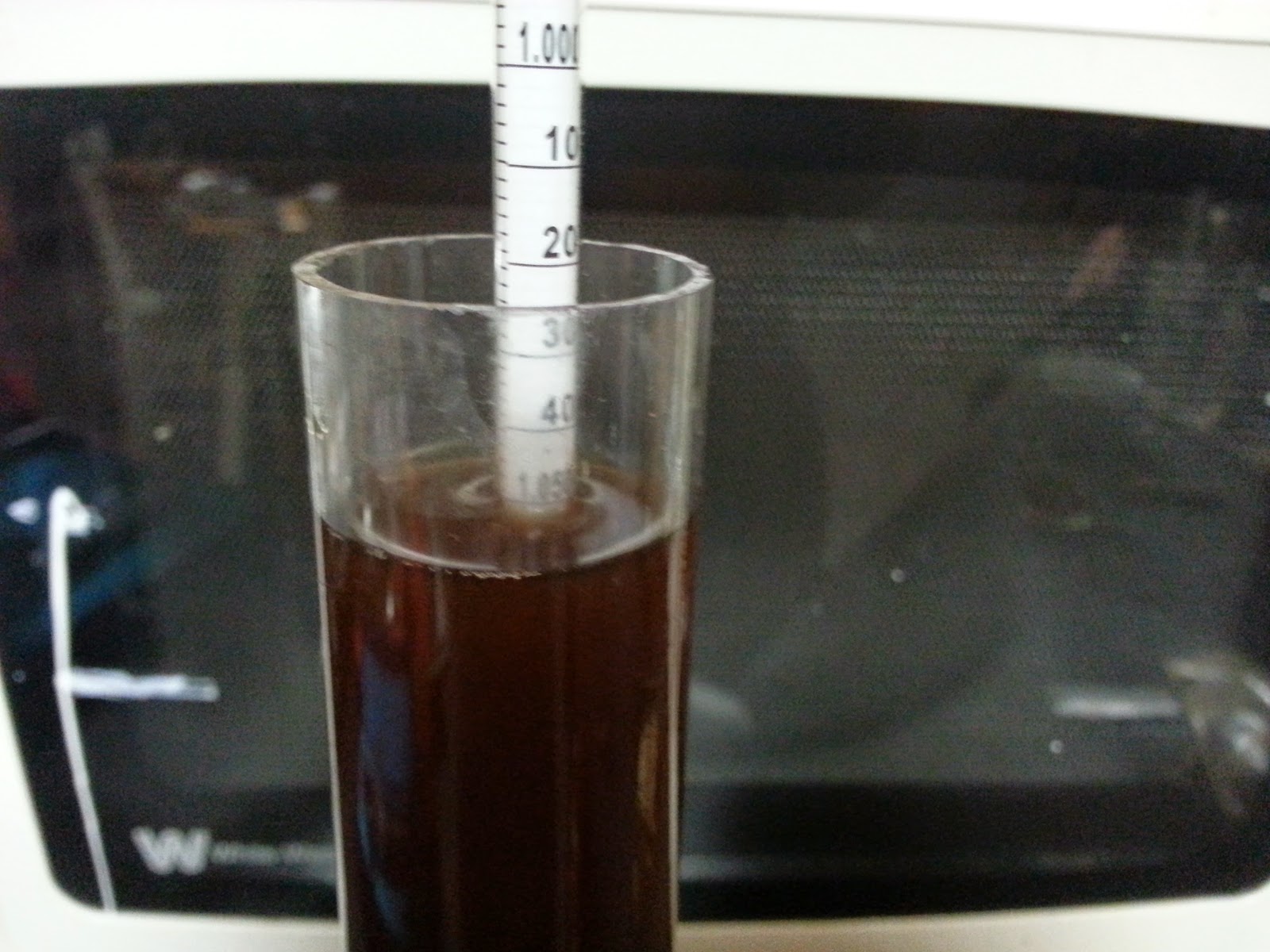
The result was surprisingly good. I sampled the beer on 1/14/2014 hoping that it would be fermented out completely after four days. The taste did not disappoint: it was dripping with grapefruit and tropical flavor from the Galaxy and Apollo whirlpool steep. But, it was still 10 points above the target FG. I let it sit for one more day then pitched 10g of Polyclar VT and loaded it up in the cooler where it would crash cool and prepare for conditioning. I've never used Polyclar before, but figured this was a perfect time to give it a shot. It would be fine for vegetarians, has a larger particle size to facilitate quick flocculation, and would be filtered out of the final product. The product specs say to allow 3-10 days for it to work. I've got 2.5. Given that I see gelatin work in 2 days, I don't see why the PVPP won't make a difference in that time frame.

For filtering, I recently picked up a beer filter kit from www.filterstore.com. I like the idea of a reusable cartridge filter rather than paper plate filters, which I haven't had good results with. That being said, I am a little worried that the .5 micron filter will strip out the delicate hop character that I achieved with late addition hops.We will see.

After 2.5 days of cold crashing, I plan on filtering this beer, force carbonating it, then bottling it. In one night. I don't know what to expect, but I've got a plan and frankly, not a lot of other options.

While I wish the process could have been less rushed with this beer, there's something exciting about being pressured to produce a quality product under the gun. I'm confident the beer will be good. At the same time, I'd be lying if I didn't say it the whole thing wasn't a carefully executed experiment of necessity.

Space monkey. Ready to sacrifice himself for the greater good.
We'll see how this guy works.

Recipe: Late Night Session Pale Ale
Brewer: Adam Keck
Date: 1/10/2014
Style: American Pale Ale
TYPE: All Grain

Recipe Specifications
--------------------------
Estimated OG: 1.043 SG
Estimated Color: 5.9 SRM
Estimated IBU: 39.6 IBUs
Brewhouse Efficiency: 80.00 %
Est Mash Efficiency: 81.8 %
Boil Time: 60 Minutes

Ingredients:
------------
Amt                   Name                                     Type          #        %/IBU         
10.00 g               Gypsum (Calcium Sulfate) (Mash 60.0 mins Water Agent   1        -             
5.00 g                Calcium Chloride (Mash 60.0 mins)        Water Agent   2        -             
14 lbs                Pale Malt (2 Row) US (2.0 SRM)           Grain         3        84.8 %        
1 lbs                 Caramel Malt - 40L (Briess) (40.0 SRM)   Grain         4        6.1 %         
1 lbs                 Carapils (Briess) (1.5 SRM)              Grain         5        6.1 %         
8.0 oz                Victory Malt (biscuit) (Briess) (28.0 SR Grain         6        3.0 %         
1.00 oz               Bravo [15.50 %] - Boil 60.0 min          Hop           7        33.9 IBUs     
0.55 tsp              Irish Moss (Boil 10.0 mins)              Fining        8        -             
1.00 oz               Bravo [15.50 %] - Boil 5.0 min           Hop           9        5.7 IBUs      
2.00 oz               Apollo [17.00 %] - Steep/Whirlpool  -30. Hop           10       0.0 IBUs      
2.00 oz               Galaxy [14.00 %] - Steep/Whirlpool  -30. Hop           11       0.0 IBUs      
1.50 oz               Centennial [10.00 %] - Boil 0.0 min      Hop           12       0.0 IBUs      
2.0 pkg               Safale American  (DCL/Fermentis #US-05)  Yeast         13       -             


Mash Schedule: Temperature Mash, 1 Step, Medium Body
Total Grain Weight: 16 lbs 8.0 oz
----------------------------
Name              Description                             Step Temperat Step Time     
Saccharification  Add 20.62 qt of water at 161.4 F        150.0 F       60 min        
Mash Out          Heat to 168.0 F over 10 min             168.0 F       10 min        

Sparge: Fly sparge with 10.32 gal water at 168.0 F

Monday, January 6, 2014

New Year, New Beer

I'd taken about a month off from brewing over the holidays. That's not to say I wasn't busy with brewing related projects...A busy holiday brewing schedule meant I was racking beer, bottling, kegging, filtering, and sampling beer to get it packaged for holiday parties and, of course, giving out my Kexxxmas Ale as gifts. Unfortunately, I didn't get to bottle and label as much of my Christmas beer as I wanted to. There will be many friends and family who receive their Kexxxmas Ale gifts in the new year.

After the hiatus, I wanted to get back to brewing in a big way, so I put together a triple brew day and invited out a few friends. On deck was a Heady Topper clone (which ended up as an Imperial Heady Topper...yikes), House Hefeweizen 1.5, and a Munich Helles.

After 18 hours of brewing, sampling, and geeking out over home brew, I've got 30 gallons fermenting.

Brew madness

Details below:

Heady Topper Clone

I have a really solid Conan culture that I've used on a handful of beers. I made a 6L starter for this monster and more or less followed theveganbrewer's fourth and final recipe from HBT. I adjusted the recipe to fit my 15 gallon kettles and sized my batch for 12 gallons, but with increased efficiency and careful inattention to detail, I seemed to have overshot my original gravity by about 13 points. I ended up with an "Imperial Heady Topper" at 1.090. Other than that, the brew went perfectly. I finally have confidence in my whirlpool and Blichmann hop blocker combination to minimize kettle hop loss and separate the beer from the massive amount of hop pellet debris.

PB OG: 1.065 @ 13.5 gallons
OG: 1.090 @ 12 gallons

Hit with a solid 3 minutes of oxygen and pitched the decanted Conan starter.

I knew something was off with my recipe when I realized how full my mash tun was

22ml of CO2 hop extract warming up on the boil kettle

The best I've done at minimizing kettle loss and keeping that pellet junk out of my fermenter
Recipe: Heady Blunder
Brewer: Adam Keck
Style: Imperial IPA
TYPE: All Grain

Recipe Specifications
--------------------------
Estimated OG: 1.088 SG
Estimated Color: 6.5 SRM
Estimated IBU: 167.9 IBUs
Boil Time: 90 Minutes

Ingredients:
------------
Amt                   Name                                     Type          #        %/IBU         
15.00 g               Gypsum (Calcium Sulfate) (Mash 60.0 mins Water Agent   1        -             
24 lbs                Golden Promise (Simpsons) (2.0 SRM)      Grain         2        68.6 %        
6 lbs                 Pale Malt (2 Row) UK (3.0 SRM)           Grain         3        17.1 %        
2 lbs                 Caramalt (Muntons) (12.0 SRM)            Grain         4        5.7 %         
2 lbs                 White Wheat Malt (2.4 SRM)               Grain         5        5.7 %         
1 lbs                 Turbinado (10.0 SRM)                     Sugar         6        2.9 %         
6.25 oz               Hop Extract [10.00 %] - Boil 90.0 min    Hop           7        113.2 IBUs    
22.00 ml              CO2 Hop Extract (Boil 90.0 mins)         Other         8        -             
2.00 oz               Columbus (Tomahawk) [14.00 %] - Boil 5.0 Hop           9        8.5 IBUs      
6.00 oz               Simcoe [13.00 %] - Boil 0.0 min          Hop           10       0.0 IBUs      
3.00 oz               Columbus (Tomahawk) [14.00 %] - Steep/Wh Hop           11       20.5 IBUs     
2.00 oz               Amarillo Gold [8.50 %] - Steep/Whirlpool Hop           12       8.3 IBUs      
2.00 oz               Columbus (Tomahawk) [14.00 %] - Boil 0.0 Hop           13       0.0 IBUs      
2.00 oz               Simcoe [13.00 %] - Steep/Whirlpool  30.0 Hop           14       12.7 IBUs     
1.00 oz               Centennial [10.00 %] - Steep/Whirlpool   Hop           15       4.9 IBUs      
1.0 pkg               Conan (Mad Fermentationist #) [35.49 ml] Yeast         16       -             
2.00 oz               Simcoe [13.00 %] - Dry Hop 8.0 Days      Hop           17       0.0 IBUs      
1.00 oz               Amarillo Gold [8.50 %] - Dry Hop 8.0 Day Hop           18       0.0 IBUs      
1.00 oz               Centennial [10.00 %] - Dry Hop 8.0 Days  Hop           19       0.0 IBUs      
1.00 oz               Columbus (Tomahawk) [14.00 %] - Dry Hop  Hop           20       0.0 IBUs      
0.50 oz               Apollo [17.00 %] - Dry Hop 8.0 Days      Hop           21       0.0 IBUs      
2.00 oz               Simcoe [13.00 %] - Dry Hop 4.0 Days      Hop           22       0.0 IBUs      
1.00 oz               Amarillo Gold [8.50 %] - Dry Hop 4.0 Day Hop           23       0.0 IBUs      
1.00 oz               Centennial [10.00 %] - Dry Hop 4.0 Days  Hop           24       0.0 IBUs      
1.00 oz               Columbus (Tomahawk) [14.00 %] - Dry Hop  Hop           25       0.0 IBUs      


Mash Schedule: Single Infusion, Light Body, No Mash Out
Total Grain Weight: 35 lbs
----------------------------
Name              Description                             Step Temperat Step Time     
Mash In           Add 42.50 qt of water at 163.5 F        150.0 F       75 min        

Sparge: Fly sparge with 8.95 gal water at 168.0 F
Notes:
------
20ml of hop extract

House Hefeweizen 1.5

I kept the recipe the same for this iteration of House Hef, but opted for 1lb of Melanoidin malt in lieu of a decoction. When you're brewing 30 gallons of beer in a day, or brewing commercially for that matter, an extra 1.5 hours and the logistics of decoction make it a nightmare. I'm also fermenting it in my 67 degree basement without a fermentation wrap. This should get it up to 72-73 degrees at peak fermentation, which should result in a little less banana character than I've pushed this beer previously. Although I really enjoy heavy banana flavors, the style is technically less aggressive. We'll see how it turns out compared to the last iterations of the recipe.

Speck und Zwiebel to go with our Bavarian brew

PB OG: 1.042 @ 12.5 gallons
OG: 1.05 @ 11.5 gallons

Gave it 2 minutes of oxygen and pitched 15g of rehydrated Safbrew WB-06.

Recipe: House Hefeweizen (1.5)
Brewer: Adam Keck
Asst Brewer: 
Style: Weizen/Weissbier (Wheat Beer)
TYPE: All Grain

Recipe Specifications
--------------------------
Estimated OG: 1.052 SG
Estimated Color: 4.7 SRM
Estimated IBU: 10.6 IBUs
Boil Time: 60 Minutes

Ingredients:
------------
Amt                   Name                                     Type          #        %/IBU         
11 lbs                Wheat Malt, Ger (2.0 SRM)                Grain         1        52.4 %        
8 lbs                 Pilsner (2 Row) Ger (2.0 SRM)            Grain         2        38.1 %        
1 lbs                 Cara-Pils/Dextrine (2.0 SRM)             Grain         3        4.8 %         
1 lbs                 Melanoiden Malt (20.0 SRM)               Grain         4        4.8 %         
0.50 oz               Hallertauer [4.80 %] - Boil 60.0 min     Hop           5        5.3 IBUs      
1.00 oz               Hallertauer [4.80 %] - Boil 30.0 min     Hop           6        5.4 IBUs      
0.50 oz               Hallertauer [4.80 %] - Boil 0.0 min      Hop           7        0.0 IBUs      
2.0 pkg               Safbrew Wheat (DCL/Fermentis #WB-06) [50 Yeast         8        -             


Mash Schedule: Single Infusion, Medium Body
Total Grain Weight: 21 lbs
----------------------------
Name              Description                             Step Temperat Step Time     
Mash In           Add 28.25 qt of water at 162.8 F        152.0 F       60 min        
Mash Out          Add 14.70 qt of water at 202.9 F        168.0 F       10 min        

Sparge: Fly sparge with 4.98 gal water at 168.0 F

Munich Helles

I had some aging Oktoberfest lager yeast in my fridge. Now that my 1972 Delfield cooler is up and running, I can finally dial in temperature control to the precision that I need for both lagers and ales. Of course, on my 14th hour of brewing I had to hit a snag: I ran my pump too aggressively at first while recirculating my mash and it sucked enough grain up to clog the wet end of my pump. Everything worked fine after I disassembled/reassembled it. I cooled to 45 degrees before pitching my WLP 820 starter - 6L decanted. Lager cooling is such a breeze in the winter time. I have an external 1/8th HP pump connected to a bucket that I use to clean kegs out. Dual purposing it couldn't be simpler. I just fill it with cold water and ice/snow and set the outflow to the input on my wort chiller and recirculate the ice cold water. After I got the temperature down to ~ 65 degrees with well water, I switched over and dropped it another 20 degrees in about 15 minutes.

PB OG: 1.042 @ 12.5 gallons
OG: 1.059 @ 11 gallons

Applied 3 minutes of oxygen and pitched the decanted 3L starters of WLP 820.

So much yeast for such a delicate beer.

Transferring to the last boil of a long day.
Brewer: Adam Keck
Asst Brewer: 
Style: Munich Helles
TYPE: All Grain

Recipe Specifications
--------------------------
Estimated OG: 1.049 SG
Estimated Color: 3.6 SRM
Estimated IBU: 18.6 IBUs
Boil Time: 90 Minutes

Ingredients:
------------
Amt                   Name                                     Type          #        %/IBU         
20 lbs                Pilsner (2 Row) Ger (2.0 SRM)            Grain         1        100.0 %       
3.00 oz               Hallertauer Hersbrucker [2.60 %] - Boil  Hop           2        17.1 IBUs     
1.00 oz               Hallertauer Hersbrucker [2.60 %] - Boil  Hop           3        1.5 IBUs      
2.0 pkg               Octoberfest/Marzen Lager (White Labs #WL Yeast         4        -             


Mash Schedule: Temperature Mash, 1 Step, Medium Body
Total Grain Weight: 20 lbs
----------------------------
Name              Description                             Step Temperat Step Time     
Saccharification  Add 25.00 qt of water at 163.7 F        152.0 F       60 min        
Mash Out          Heat to 168.0 F over 10 min             168.0 F       10 min        

Sparge: Fly sparge with 11.15 gal water at 168.0 F
Notes:
------

Update:

Heady Blunder (Heady Topper clone gone imperial)

I fermented this at 68 degrees for four days then bumped up the temperature to 71 degrees. On 1/8/2014, it recorded a ~1.030 specific gravity. The color is a very intense dark orange. Probably darker than Heady Topper. The flavor was extremely fruity with signature Heady Topper dankness. I didn't taste any of the sweetness that comes with a 1.030 gravity, as the hops covered it up entirely. The Conan "peach" flavor was there, but not pronounced.

Fiery orange.
I took the heat off of the fermenter on 1/13/2014 and will let it crash cool to 38 degrees while I am on vacation next week. I opted to let the beer sit, rather than rush to dry hop it. This will be the first time I do a two stage dry hop in earnest. I want to do it right.

House Hefeweizen 1.5

Transferred 10 gallons to kegs on 1/14 after 10 days in the primary. FG: 1.010, kegged at 30 psi. The sample was as expected: a little more reserved on the banana notes due to the cooler fermentation. It also had a different texture than I remember in the last batches. This could be a result of it not being carbonated and not representative of how the final beer will come out or it could actually be a result of skipping the decoction mash (and the protein rest that comes with it). We'll see on the final beer.

Munich Helles

Checked the gravity on 1/15 to see if it was ready for a diacetyl rest. SG: 1.020. Bumped up the temperature to 57 degrees. I'll leave it set for 2 days then I'll begin to cool the beer down to lagering temperature. This is probably the most malt focused beer I've done and even with the unfinished yeast business, the prominent taste was bready, pilsner malt. I used 100% Avangard Pilsner malt in the grist and it shows off.


Update 2:

Heady Blunder

After crashing for a week, the beer came out much clearer. I transferred with CO2 by installing a spear in my sanke fermenter. I added the first round of dry hops on 1/27, the second round on 1/30, then put the corneys in the fridge for crashing on 2/2. I've been dry hopping in the keg with nylon socks. Looking forward to tasting what the 2-stage dry hop will do for this beer. Later this week, I'll pull samples of the beer till it is clear then transfer to clean kegs for serving. 

One week @ 38 degrees cleared the beer out really nicely, even without finings

Munich Helles

I was thinking about filtering this beer into serving kegs, but then I drew a sample and saw how crystal clear it was after two weeks of lagering. I tasted it for any diacetyl or off flavors before deciding whether I'd lager it longer or package it for serving. There were no off flavors. It tastes delightful. I transferred it into two corney kegs then set the kegs on 10 psi of gas. I intend to serve one keg within the week and bottle a few of them and the other I'll allow to lager longer to see if there is a noticeable flavor improvement.

I'm a little thrown off by the FG: 1.020. I suppose I could have allowed it more time to ferment, but I really thought that the diacetyl rest at 58 degrees for two days would have finished it out. It didn't move a single point of gravity. The attenuation for WLP820 lager is 65-73% and from 1.059 to 1.020, I hit the low end of the scale at 66% apparent attenuation. Next time, I'll pitch a larger starter (easier now that I've salvaged the yeast) and I'll allow it a full 2.5 weeks to ferment.

The sample was excellent though, and I didn't sense any extra sweetness.

Crystal clear.

Thursday, August 22, 2013

Cream Ale 1.2

Minerva's Cream Ale 1.2
8/15/2013

I love this beer.

Mashed at 148 for 50 minutes then raised temperature slowly to 168.

Collected 13 gallons of 1.048 wort.

Boiled for 60 minutes, chilled 11.5 gallons to 55F @ 1.056. Pitched a 4L starter of California Lager yeast.

Since I have more precise fermentation temp, I'm going to ferment this right at 60 for a 3-4 days, ramp up to 62, then up to 65-66 for a diacetyl rest once I've hit ~85% of fermentation.


I think contrary to many homebrewers, I've spent a lot of my time and capital on brewing classic styles like Cream Ale, Kolsch, Porter, Hefeweizen, ESB, Dry Stout, etc. rather than brewing "extreme" beers. Early on, I bristled at containing my ABV at 5-6% or less or dialing down my hop additions to stay in guidelines. And don't get me wrong, I've brewed big beers and done experimental brews, but they're probably less than 30% of what I've ended up brewing. I think a lot of this has to do with my audience and the fact that I'm brewing a lot for events, fundraisers, and family, rather than for myself and beer friends. I want to switch this up a bit, and take what I've learned about brewing very technically sound classic beers to some more innovative varieties. Looking at my brewing schedule, I'm tied up the next few brews with "production" brews, as well as a heavy regiment of Kexxxmas Ale. I really love doing these beers and events - I get to talk to people that don't normally choose to drink craft beer and I get to hone my classic recipes - but deep down I want to be more creative.

At the end of the day though, having people that want your beer is a great thing. I'm always happy to brew. But I anticipate any "free" future brewing time to be put towards some seriously interesting brews.


Thursday, August 1, 2013

House Hef 1.3 2

Loving marathon brew week.

PB OG:  1.040 @ 12 gallons. I'm undershooting this batch to even out the other one. 5 gallons of this batch will top off the other 10 to make a 1/2 barrel keg for serving.

FG: 1.050 @ 11 gallons. Right where I want to be.


Tuesday, July 30, 2013

Apartment brew series - Stormy Night English Dark Mild

I brewed an English Dark Mild last week in my apartment. It's something I've wanted to do for awhile, but kept putting off for brewing on my big boy system. I'd like to have a series of 5 gallon batches bottled on hand at the apartment. Basically, I want to relax, brew, bottle, and be able to watch my beer through the whole process, rather than stress about it being 30 minutes away. There was something truly nice about being done with a brew in 3.5 hours and on the couch relaxing.

 I haven't done this in awhile...

 Thanks to Gregg at the Pumphouse for this sample of Mangrove Jack yeast. Rehydrated according to online instructions.

 Added the DME right before the boil.

 I think I'll have to stick with 3-4 gallon boils. My electric range stove was just about perfect for this volume. Boiled for 60 minutes with three additions of Fuggles.

 I like to think Ben would be happy with the brew. He had an affinity for English Ales.

After 5 minutes of manual aeration/workout.

 Collected a little more wort than I wanted, but no big deal. 1.052 @ 6 gallons.

A giant igloo cooler, check. Frozen jugs, check. Kickass consistent ale ferment temperature, check. Fermented at 65 degrees for 3 days, then let it sit in our ambient apartment ~70 degrees.

Update: 8/22/2013 - Two weeks ago I set myself up to bottle until I realized that my fermentation got stuck around 1.020. I pitched a full sachet of Danstar Windsor Ale yeast and gave it another two weeks. I didn't see any fermentation activity in my bubbler, so I assumed it was just stuck and I'd bottle it despite its high FG. Well, last night I realized that the bucket lid wasn't on all the way... It tasted more mature, but I didn't sense oxidation, so I bottled it with Muntons carbonation tabs @ 1.012 FG.

BeerSmith 2 Recipe Printout - http://www.beersmith.com
Recipe: Stormy Night English Dark Brown
Brewer: Adam Keck
Asst Brewer: 
Style: Northern English Brown Ale
TYPE: Extract
Taste: (30.0) 

Recipe Specifications
--------------------------
Boil Size: 3
Post Boil Volume: 5.73 gal
Batch Size (fermenter): 5.00 gal   
Bottling Volume: 4.78 gal
Estimated OG: 1.053 SG
Estimated Color: 21.5 SRM
Estimated IBU: 27.3 IBUs
Brewhouse Efficiency: 65.00 %
Est Mash Efficiency: 0.0 %
Boil Time: 60 Minutes

Ingredients:
------------
Amt                   Name                                     Type          #        %/IBU         
8.0 oz                Caramel/Crystal Malt - 40L (40.0 SRM)    Grain         1        7.1 %         
8.0 oz                Chocolate Malt (350.0 SRM)               Grain         2        7.1 %         
6 lbs                 Amber Dry Extract (12.5 SRM)             Dry Extract   3        85.7 %        
1.00 oz               Fuggles [4.50 %] - Boil 60.0 min         Hop           4        16.1 IBUs     
1.00 oz               Fuggles [4.50 %] - Boil 15.0 min         Hop           5        8.0 IBUs      
1.00 oz               Fuggles [4.50 %] - Boil 5.0 min          Hop           6        3.2 IBUs      
1.0 pkg               Newcastle Dark Ale (Mangrove Jack #MO3)  Yeast         7        -             

House Hefeweizen 1.3 1

Suddenly I had to brew twenty gallons of Hefeweizen within a week and a half. I guess I don't need to sleep this week!

With the short time frame, I didn't really have any time to make a proper starter with Wyeast 3068 like I normally do for my house hef. It's served me really well, but alas, I'm not going to spend over $40 on enough liquid yeast packs to pitch raw. That led me to dry yeast options. I read thoroughly over Danstar Munich and Safbrew WB-06 reviews on homebrew forums and was initially really unimpressed. I then read Fermentis's details page for their yeast. The manufacturer says that WB-06 will accentuate banana flavors at over 22C and clove under 22C. Since I assumed the banana flavors are what brewers were disappointed by, I hypothesized that the brewers in question weren't getting their ferments up consistently to 72 degrees or higher. I then checked probrewer.com and found this awesome post from a brewer in Akron with several GABF and WBC awards won by Fermentis yeast. Hmm... He had some great things to say about WB-06 with three caveats: push fermentation temperature to and beyond its limits, underpitch, and don't aerate. WTF?

I'm suddenly excited about using this dry yeast! 

It makes me realize also how valuable probrewer.com is. There's an extra degree of creativity when the profit motive or scarcity is introduced and brewers are forced to make great beer with equipment and process tweaks in lieu of ideal ingredients every single brew. 

I'm going to ferment just past the recommended upper bound and go for 75 degrees F, 23.9C. 

I also had to sub in 2 lbs of white wheat malt because I made a LHBS pickup mistake. And like last time I'm adding some carapils for head retention - I really want that classic sticky lacing on the side of maßkrug next Saturday!

Mashed in at 130 degrees for protein rest for 35 minutes; did a combination temperature and infusion mash to 156 for 45 minutes; then decocted 3 gallons and boiled for 15 minutes. Collected about 13.25 gallons of wort and started boiling. I've been doing so many whole leaf IPAs lately that it's strange throwing in half an ounce of hops for a bittering addition.

PB OG: 1.039 @ 13.25
OG: 1.045 @ 12 gallons

The boil is throwing off such a distinct sweet wheat aroma. I don't know why I'm picking it up so strongly now. I think this will be a great beer. I'm hoping the white wheat gives it a little more subtle bready flavor.

Pitched about 15g of rehydrated dry yeast into unaerated wort. Set fermentation temperature for 73 degrees knowing that with ambient temperature at 65 degrees, it'll mosey on up to 75 degrees and likely above with the fermentation activity.

I get to brew it again tomorrow.

UPDATE: the fermentation is going crazy and the internal temperature is at 79F. Part of me is wishing that I would have made room in my fermentation chamber to control the temp more and part of me is looking forward to tasting what the enhanced fermentation temperature is going to produce! I'll update with taste results.

Update 2: tested the gravity on 7-31 and was blown away. It's just about fermented out after only two days - 1.015. The banana flavor is very, very prominent. If it's any telling, I won't be disappointed with WB-06 fermenting at ~80F.

Update 3: My mom says this is the best the House Hefeweizen's been, so the WB-06 isn't a bust for sure. It's definitely got more flavor than 3068 fermented at 62 degrees.


BeerSmith 2 Recipe Printout - http://www.beersmith.com
Recipe: House Hefeweizen (1.3)
Brewer: Adam Keck
Asst Brewer:
Style: Weizen/Weissbier (Wheat Beer)
TYPE: All Grain
Taste: (30.0)

Recipe Specifications
--------------------------
Boil Size: 12.70 gal
Post Boil Volume: 11.70 gal
Batch Size (fermenter): 11.00 gal
Bottling Volume: 10.75 gal
Estimated OG: 1.050 SG
Estimated Color: 3.6 SRM
Estimated IBU: 10.8 IBUs
Brewhouse Efficiency: 72.00 %
Est Mash Efficiency: 73.6 %
Boil Time: 60 Minutes

Ingredients:
------------
Amt                   Name                                     Type          #        %/IBU      
1 lbs                 Rice Hulls (0.0 SRM)                     Adjunct       1        4.8 %      
9 lbs                 Wheat Malt, Ger (2.0 SRM)                Grain         2        42.9 %      
8 lbs                 Pilsner (2 Row) Ger (2.0 SRM)            Grain         3        38.1 %      
2 lbs                 White Wheat Malt (2.4 SRM)               Grain         4        9.5 %      
1 lbs                 Cara-Pils/Dextrine (2.0 SRM)             Grain         5        4.8 %      
0.50 oz               Hallertauer [4.80 %] - Boil 60.0 min     Hop           6        4.3 IBUs    
1.00 oz               Hallertauer [4.80 %] - Boil 30.0 min     Hop           7        6.6 IBUs    
4.00 tsp              Yeast Nutrient (Boil 15.0 mins)          Other         8        -          
0.50 oz               Hallertauer [4.80 %] - Boil 0.0 min      Hop           9        0.0 IBUs    
2.0 pkg               Safbrew Wheat (DCL/Fermentis #WB-06) [50 Yeast         10       -          


Mash Schedule: Decoction Mash, Single -> Braukeiser
Total Grain Weight: 21 lbs
----------------------------
Name              Description                             Step Temperat Step Time  
Protein Rest      Add 27.20 qt of water at 138.2 F        130.0 F       35 min      
Infuse to Sacchar Add 16.80 qt of water at 198.3 F        154.0 F       45 min      
Decoction to Mash Decoct 12.20 qt of mash and boil it     168.0 F       15 min      

Saturday, July 27, 2013

SimConan IPA

I grew a Conan yeast culture from a can of Heady Topper that my lovely friend Alaina brought home from Vermont. When I realized that Simcoe went so well with Conan yeast linguistically, I figured that it follows that it would make great beer in this minimalist recipe.

I decided to doll up the malt bill with a touch of wheat to see how the apricot notes of the Conan yeast played off a little wheatness in the beer. I also added a bit of Munich because, well, why not. A half pound of caramel 40 for color and complexity.

Mashing in light at 148. Held steady at 148-150. Heated to 168 for mash out.

PB OG 1.048.

Boiled strong for 60 minutes. I thought I had an extra ounce of Simcoe, so we'll have to go with 3 oz of knockout hops instead of 4. Chilled to 180 degrees and let sit for a 30 minute hop stand.

There's an incredible pine aroma coming off the wort from the knockout addition. It's filled up the entire garage. Lots of hop oil floating on top of the wort as well.

Forgot whirlfloc....

OG: 1.069

This thing is going to be a monster. Can't wait to see what Conan does to it. Speaking of, I have no idea what temp I'm going to ferment this thing at. Vacillating between a low ale ferment around 64 degrees like I would an English Ale yeast or going higher to make sure I get some apricot/peach notes. I wish I knew what the Alchemist ferments Heady at.

I think I'll follow this:

In Mitch Stelle's IPA book, the El Jeffe (dark IPA) recipe from The Alchemist mentions fermenting at 68F for 3 days then raising to 72F. Using it at 66F (slightly cooler to make up for the lack of pressure provided by a large conical) seems to be the "normal" use of the yeast for the brewery. I doubt he treats the yeast differently for Heady vs. other hoppy beers. That's what I'll be shooting for in my next beer.
66 degrees for 3-4 days then turned up to 70 to finish it out.

Update: tested the gravity on 7-31, about four days after pitching, and it's just about cleaned out at 1.016. The taste was very unique. Almost like fruit juice between the late kettle Simcoe and the peach flavor from the yeast. I might have to rename it as a Pale Ale, because there's not much bitterness detected. I'm also toying with the idea of adding a few ounces of Columbus to give it a little resin/dank flavor. Then again, I might just leave it be at six ounces of Simcoe dry hop. Decisions...

Update: I ended up dry hopping 5 gallons with 4 oz Simcoe and 5 gallons with 2 oz Columbus and 2 oz Simcoe. I wanted to mix it up and bump up the dry hopping volume because, well, the two oz. of Magnum bittering were absolutely overpowered by the Conan yeast. That's all I can figure out! It went into the fermenter tasting like I thought it should for 2 oz of Magnum and came out tasting mild. In fact, I think I'm going to serve it as a pale ale.

That being said, the dry hop flavor is amazing. It's ridiculously fruity. It really needs more bittering, but a fair beer at any rate and a good first try with Conan yeast.

BeerSmith 2 Recipe Printout - http://www.beersmith.com
Recipe: SimConan IPA
Brewer: Adam Keck
Asst Brewer:
Style: American IPA
TYPE: All Grain
Taste: (30.0)

Recipe Specifications
--------------------------
Boil Size: 15.00 gal
Post Boil Volume: 14.00 gal
Batch Size (fermenter): 12.00 gal
Bottling Volume: 11.75 gal
Estimated OG: 1.066 SG
Estimated Color: 5.4 SRM
Estimated IBU: 59.4 IBUs
Brewhouse Efficiency: 72.00 %
Est Mash Efficiency: 73.7 %
Boil Time: 60 Minutes

Ingredients:
------------
Amt                   Name                                     Type          #        %/IBU      
10.00 g               Gypsum (Calcium Sulfate) (Mash 60.0 mins Water Agent   1        -          
23 lbs                Pale Malt (2 Row) US (2.0 SRM)           Grain         2        80.7 %      
2 lbs                 Wheat Malt, Ger (2.0 SRM)                Grain         3        7.0 %      
1 lbs                 Munich Malt (9.0 SRM)                    Grain         4        3.5 %      
8.0 oz                Caramel/Crystal Malt - 40L (40.0 SRM)    Grain         5        1.8 %      
2 lbs                 Cane (Beet) Sugar (0.0 SRM)              Sugar         6        7.0 %      
2.00 oz               Magnum [14.00 %] - Boil 60.0 min         Hop           7        41.9 IBUs  
2.00 oz               Simcoe [13.00 %] - Boil 15.0 min         Hop           8        17.5 IBUs  
3.00 oz               Simcoe [13.00 %] - Boil 0.0 min          Hop           9        0.0 IBUs    
3.0 pkg               English Ale (White Labs #WLP002) [35.49  Yeast         10       -          
6.00 oz               Simcoe [13.00 %] - Dry Hop 7.0 Days      Hop           11       0.0 IBUs    


Mash Schedule: Temperature Mash, 1 Step, Light Body
Total Grain Weight: 28 lbs 8.0 oz
----------------------------
Name              Description                             Step Temperat Step Time  
Saccharification  Add 33.12 qt of water at 159.1 F        148.0 F       75 min      
Mash Out          Heat to 168.0 F over 10 min             168.0 F       10 min      

Sparge: Fly sparge with 10.40 gal water at 168.0 F
Notes:
------